Warning: this blogpost contains talk about feelings, and some puzzle jargon.
The current state of affairs is not all bad. Yes, I am currently unemployed and under some sort of house arrest. My social life is limited to one human, and a shitload of creepy bugs. But it has let me explore new avenues; areas i’d never expect to find myself in.
Before the COVID-mania hit us and shut down the world, we were constantly on the move. We went from one city to the other, and switched hotels almost daily. Back home we were also on full Duracell-mode. If we wanted a free, unplanned day, we would have to plan that two months in advance. There was hardly any room for spontaneity or to stop and think about what the hell we were doing with our lives. But having some time away with all the time in the world without distractions has made me realise a few things so far.
1: I have been lying to myself
Like many others, I am the proud owner of a to-do-in-life-list. A colourful collection of ambitions and projects I want to achieve if and when I’d get around to it. On my personal list:
- Learn to speak Tamang (Nepali ethnic group)
- Learn sign language
- Improve my Spanish
- Learn to play bass guitar
- Film a documentary
- Write a book
- Write a business plan
- Design a software
- Design a new website
- Create photo albums of our holidays/travels
And here comes life… “BAM! Here you have it. Time – lots of it. You’ve got your laptop, a stable internet connection, and a different timezone so your friends will be asleep when you’re awake. There’s no more excuses not to dive into that project that has been gathering dust on the shelf, waiting for a rainy Sunday afternoon. Get started.”
For the past month in Australia, I’ve been mostly working on all excuses as to how not to get started on any of my to-do-list-projects. To a point I was actually glad that my laptop was overheating in the sun, so I could put it aside to let it cool down for about 8 hours. I’ve spent hours on ‘random word generator’, in search for a new company name. I’ve watched countless series and am reading about 7 books at a time, for the purpose of “character research”. Not knowing where to start on my list, I often find myself “polar-bearing” in the garden (Dutch way of saying: ‘pacing back and forth’).
I’ve come to the conclusion I might not want to do half of the things on the list. But what do I do now? Do I save the projects on the list for a better moment, or do I have to come to terms with the fact that I’m never going to do all these things anyway? The last option comes with a sense of guilt. That feeling strikes me as strange. Why do I have to feel guilt for not doing things I don’t really want to do? Why does every minute of my day need to feel productive? Do I really need to complete all those life ‘add-ons’ in order to be proud of myself? What’s wrong with being just a healthy, functional member of society with a normal skillset and career? Why this need for being this overachieving, straight A student?
Rather than forcing myself to cross off items from my to-do-list, I’ve added a life-goal to my list: an exploration of the true self. For the first time in my life I do not have to do anything. There’s some money left from my travel budget to keep me afloat, and there’s not a single deadline I have to meet. Therefore, I can start every day with a clean sheet. I started to focus on whatever comes to mind on a daily basis, and started giving everything I have (and want) to give for that purpose. It’s been great so far. I’ve noticed I really enjoy writing. I spend many hours of my day reading and writing down all kinds of silly stuff that comes to mind. Who knows, I might just get good at it.
2: There is more to jigsaw puzzles than meets the eye
One of the unknown territories I’ve found myself on, is the one of jigsaw puzzle. I, and undoubtedly many other with me, have gravely underestimated the magic of completing a jigsaw puzzle.
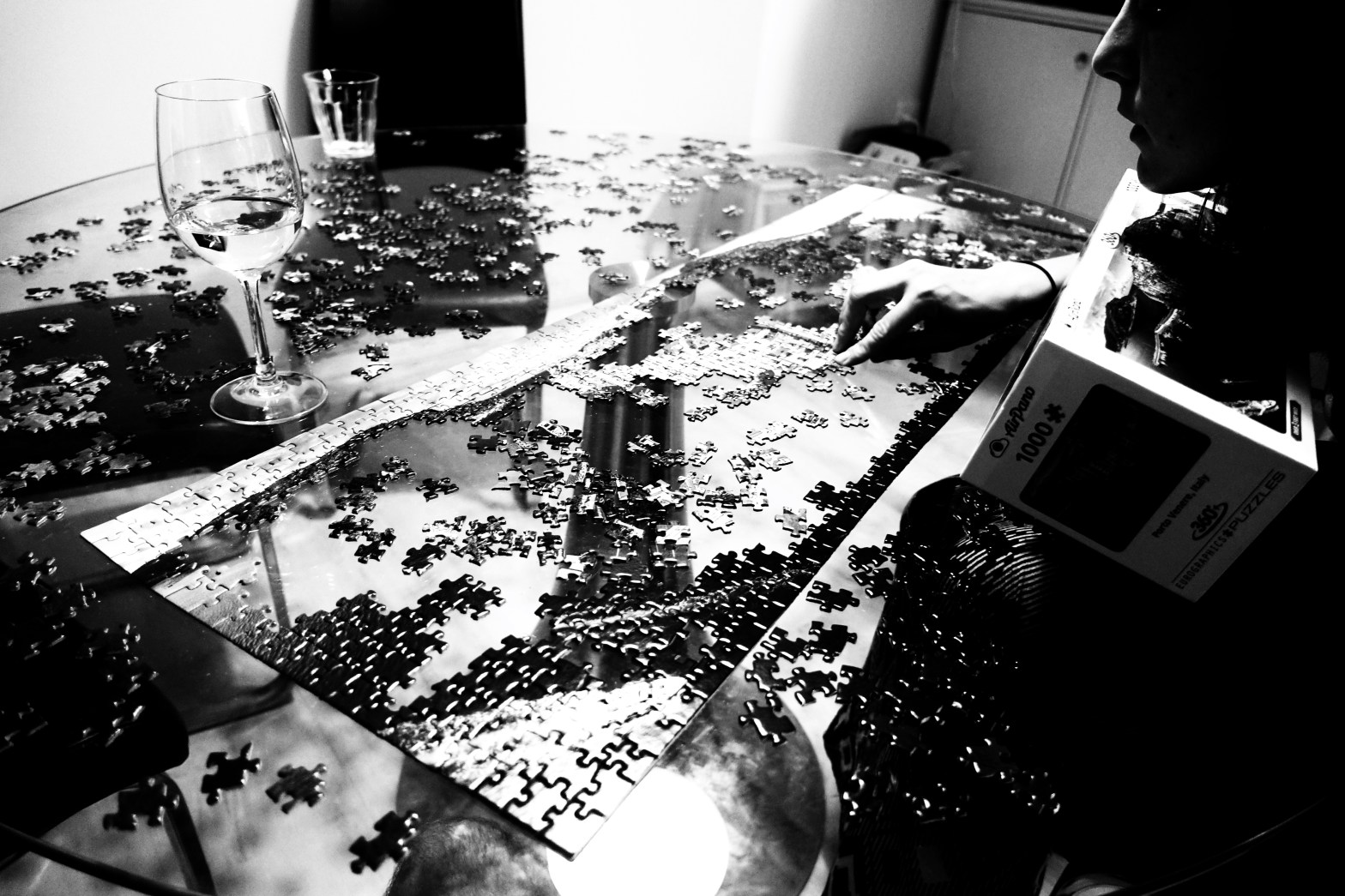
My last rendezvous with this beautiful game was more than 20 years ago. Not once in my adult years has the thought come to mind to stay in and complete a puzzle. It was a mere coincidence that our AirBnb-jail was also home to a 500 piece puzzle of a few boots and some flowers. As mentioned in my previous blog, we completing this in a curse and a sigh (Dutch way of saying ‘in no time’). We went on a hunt to buy more puzzles. We are not the only souls on a jigsaw mission. The world seems more drawn to connecting puzzle pieces, than connecting with other people. Puzzles do not spread viruses, they only spread joy (cheeeeeeeese).
There is a global shortage of jigsaw puzzles. Difficult to get a good one. Yesterday, after many weeks of trying to buy a new puzzle, we got our hands on a 1.000 piecer. Portraying a scenic panorama of Porto Venero, Italy. Since you have come this far reading this blog, I’m going to assume you are also interested in reading what has gone through my mind in the past 24 hours, regarding puzzles.
- There’s many emotions involved with jigsaw puzzles.
Say what you want, but there’s nothing like sweating over a messy stack of interconnecting males and females, intensely focused on finding mating connections. (Puzzle jargon gets kind of dirty…). You can spend minutes or hours looking for that perfect interlock, only to get convinced that you are the unlucky owner of a puzzle with a missing piece. The absence of that perfect piece can lead to feelings of discomfort. But do not despair! Move to another seat, and focus on another part of the puzzle. Get lost in staring at identical but different pieces of the cobblestone pavement, and forget you were ever looking for that one missing flower pedal. I promise it will suddenly appear when you least expect it.
- The ultimate strategy for success.
I think it’s safe to say that you’ll find success by focussing on the edges (free life lesson). Scout the puzzle for pieces with one flat edge, and colour code these. If you find a piece with two flat edges, you are in luck because you have hit a corner (unless you have a round puzzle). Build the contours of the puzzle. Then, gaze over the puzzle pieces and sort by colour. Start “colouring in” the puzzle. Closely study the example picture and find the most distinguishable object, which is close to the edges. Find the puzzle piece that shows the biggest bit of the object you chose. Work from there. Ah it’s magical.
- We, humans, have incredible minds.
It’s not uncommon that you find your hand subconsciously moving towards a specific piece of the puzzle. Without you being conscious of your brain sending a message to your hands, it seems to move on its own. If you let it and try not to think about it, you find that your hand carries that piece to the perfect spot in the puzzle. In this process, your brain has made a connection with other colour codes and shapes so quickly, that you couldn’t even keep track of this process. I can only assume it’s a gift we got from our early ancestors, who could only survive due to their impeccable spotting and gathering skills. Enjoy it, and think about how amazing you are just for being able to do this.
- A jigsaw carries conversations well.
As laying jigsaw puzzles is something that we do instinctively by connecting shapes and colours, we don’t have to put in too much mental effort. It’s like your brain steps up a gear. When you focus on a jigsaw, the other distractions in the room disappear. You’re only focussed on that puzzle, and you see details very cleary. You can use this clarity in conversation with your puzzle-companion. You’re not actively engaging your entire brain for this, but your brain is on high alert. I found this makes it easier to make connections in your conversation. (This statement is by no way proven, and only my interpretation). Also, when you are engaged with someone in the act of connecting loops and sockets, you don’t make eye contact. This has the same effect as when you’re driving a car and having a chat with the person in the passenger seat. Often there’s just less tension when your conversational partner is not staring into your eyes during a difficult conversation.
- People portrayed on jigsaws, live forever.
Never have I searched so long for one man standing on the balcony on a distant rooftop portrayed
on an Italian skyline. Puzzles get really old. Jigsaw enthusiasts will be hunting for this man for many years to come, without him even knowing it. What a world we live in.
In short: I’ve got a lot of time on my hands and not enough jigsaw puzzles.
 Pete & Jo on the go
Mooi verhaal Jorien😀 ik denk dat er veel “stoffige”puzzels tevoorschijn zijn gehaald overal. 😘
LikeLike